
Chapter 5 — Narmer Returns Circa 3200 BCE
Final Chapter of "Arrival of the Gods"

Chapter 5 — Narmer Returns Circa 3200 BCE
Narmer scanned the bloody battlefield. His soldiers were busy piling the dead bodies of their northern enemies onto oxen-drawn carts. These few stalwart men had fought to the bitter end for their northern king, but to little avail. The country would now be united under one ruler, and he would be the first in a long line of pharaohs.
The northern campaign into the delta had been difficult at first. Narmer’s men had been unfamiliar with the boggy ground, having trained only on the sandy and hard scrabble banks of the upper Nile. Fortunately, they had an advantage that could not be overcome by mere mortals. They were being led by the legendary Favorite of the Gods, as Narmer had often been called.
Almost three centuries earlier, Narmer had predicted the coming of Djehuty and Ma’at, and then he had been taken into the sky by those gods as a reward for his faithfulness. His return was foretold in writing on the temple walls in the northern capital of Thinis.
When he appeared - unannounced - in that temple two years earlier, some of his followers even thought that he might be one of the Gods. Narmer’s quick rise to power in the south, followed by his successful campaigns in the north only bolstered those claims.
“Scribe! Come forward,” he yelled over the din of the noisy clean-up effort.
“How may I serve you?” queried young Anukha as he hurried up the hill. This was not the first time he had been summoned after a victory, but perhaps it might be the last. He was ready.
“Anukha, I need you to observe this scene from the hilltop. Note as many details as possible and then record your observations. This moment in time is critical to the establishment of our kingdom. The north will now be united with the south, and I will wear the crown of both kingdoms when I return to Thinis. Once you have completed this task, send your scroll by messenger to my queen so that she may prepare for the celebration.”
“As you command, my King,” Anukha said reverently with a modest bow. He then moved to the crest of the hill and turned in a complete circle from north to east to south to west and then back to the north once more. No detail could be missed. Sitting down on the ground, he pulled out a scroll, placed it on his wooden lap desk, and began feverishly recording what he had observed.
“Pause for one moment, Anukha,” Narmer commanded. “I want you to include a message of praise and thankfulness to Ra for guiding us to this great victory and also to Djehuty for giving us the means of recording events for our descendants. We must never forget that we are the blessed people of the Gods. It is because of Their intervention in our lives that we have been able to accomplish this great victory. Make sure that you include this in your message to the queen.”
“As you command, my King,” Anukha replied, bending over and continued his writing on the scroll. His time in the temple had prepared him well for this sacred task, and he would not fail.
“All praise to Ra for your glorious victory this day! Let the Gods rejoice!”
Narmer Palette
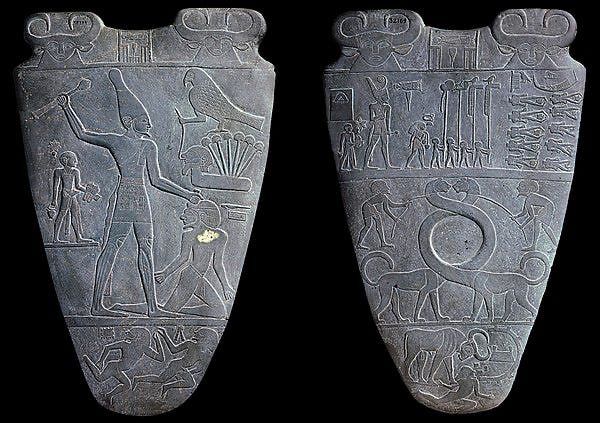
In this picture both sides of the Narmer Palette are shown
Material
Size
c. 64 cm × 42 cm
Created
3200–3000 BC (circa)
Discovered
1897–1898
Discovered by
Present location
Identification
CG 14716
The Narmer Palette, also known as the Great Hierakonpolis Palette or the Palette of Narmer, is a significant Egyptian archaeological find, dating from about the 31st century BC, belonging, at least nominally, to the category of cosmetic palettes. It contains some of the earliest hieroglyphic inscriptions ever found. The tablet is thought by some to depict the unification of Upper and Lower Egypt under the king Narmer.
From Wikipedia
Pre-dynastic period
Although the archaeological site of Thinis has never been located,[13] evidence of population concentration in the Abydos-Thinis region dates from the fourth millennium BCE.[13][14] Thinis is also cited as the earliest royal burial-site in Egypt.[15]
At an early point, the city of Abydos ceded its political rank to Thinis,[16] and although Abydos would continue to enjoy supreme religious importance,[16] its history and functions cannot be understood without reference to Thinis.[12] The role of Thinis as centre of the Thinite Confederacy is taken from Manetho,[17] although there are still Dynasty I and late Dynasty II royal tombs at Abydos, the principal regional necropolis.[17]
From Wikipedia